
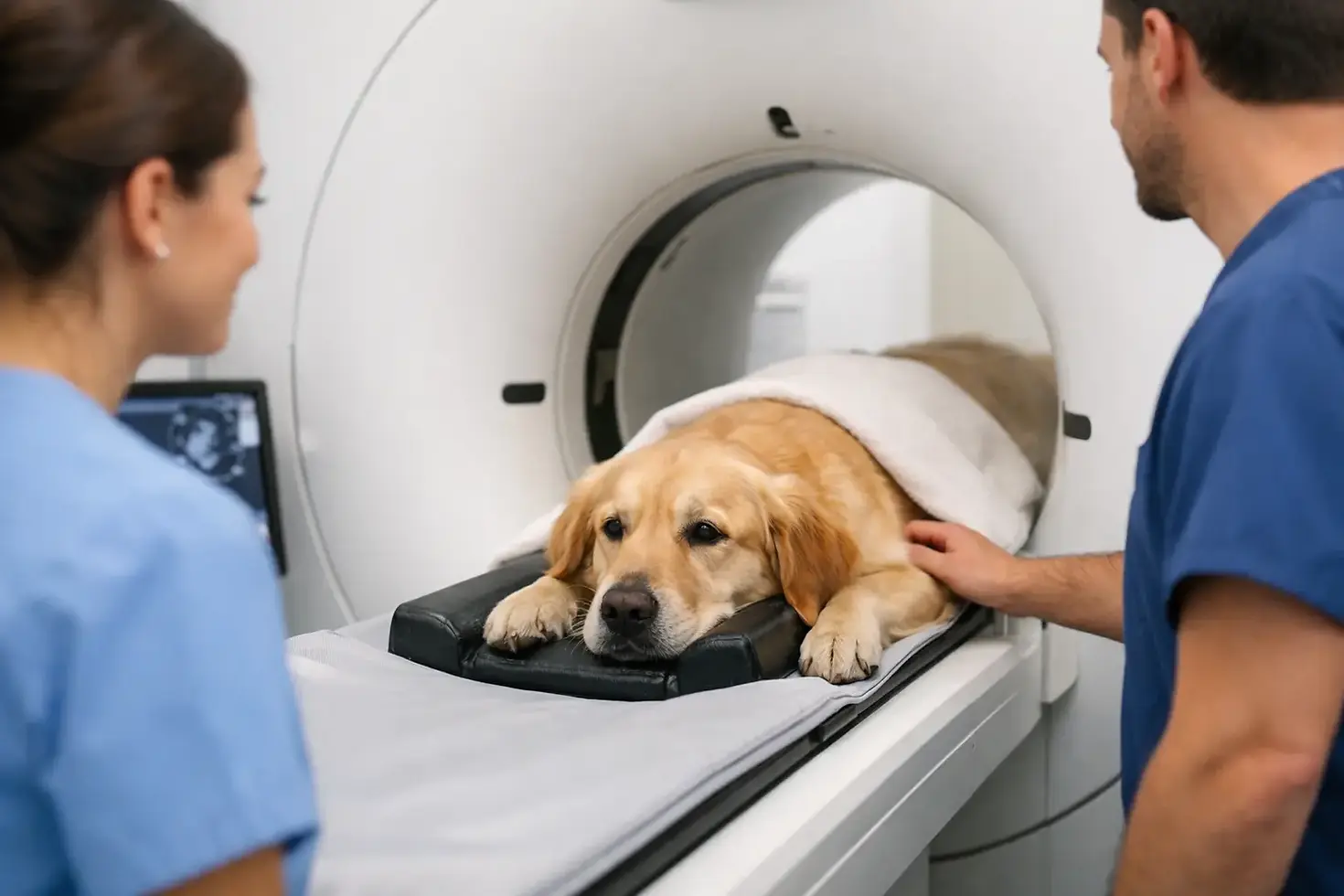
CT scan for dogs: when is it needed?
- Vet Nurse Emily
- 23 hours ago
- 6 min read
When your dog is unwell and the answers are not obvious on a physical exam or standard X-rays, a CT scan for dogs can be the test that changes the next step. It gives vets a far more detailed look inside the body, which matters when time is short, symptoms are complex, or surgery needs careful planning.
For many owners, the idea of advanced imaging sounds daunting. That is completely understandable. Most people first hear about CT in the middle of a stressful moment - after an injury, during an emergency visit, or when a persistent problem still does not have a clear cause. Knowing what the scan is for, why your vet has recommended it, and what to expect can make the process feel much more manageable.
What is a CT scan for dogs?
A CT scan, or computed tomography scan, uses X-rays and computer processing to create highly detailed cross-sectional images of your dog’s body. Instead of producing a single flat image, it builds a layered picture that can show bone, soft tissue, airways, blood vessels and internal structures with much greater clarity.
That extra detail is the main reason CT is so valuable. In straightforward cases, standard imaging may be enough. But when your vet needs to assess the skull, chest, spine, joints, nasal cavity, abdomen, or a suspected mass in more depth, CT can provide information that is difficult to get any other way.
It is not a test every dog needs. It is a targeted tool, used when the likely benefit is clear.
When a CT scan for dogs is recommended
A CT scan for dogs is often recommended when there are signs of a serious condition, when other tests have not provided enough information, or when treatment decisions depend on a more precise diagnosis.
One common reason is trauma. If a dog has been hit by a car, suffered a major fall, or sustained a jaw, skull or chest injury, CT can help identify fractures and internal damage that may not be fully visible on plain radiographs. In emergency care, that level of detail can directly affect surgical planning and stabilisation.
CT is also frequently used for investigating nasal disease. Dogs with persistent sneezing, nosebleeds, facial swelling or noisy breathing may have inflammation, infection, foreign material or a tumour within the nasal passages. These areas are complex and crowded, which makes CT especially useful.
In orthopaedics and spinal cases, CT can clarify fractures, joint abnormalities and some forms of spinal change. It is often used when a dog is lame but the cause remains uncertain, or when surgery is being considered and the surgeon needs a better map of the problem.
Cancer investigation is another major reason. If a mass has been found, CT may help define its size, location and involvement with nearby tissue. It can also be used to look for spread to the chest or other regions. That does not always mean the news will be worst-case. Sometimes CT helps confirm that a lesion is more localised than expected, which can open the door to treatment.
For some dogs, CT is part of investigating long-running symptoms such as unexplained pain, chronic ear disease, breathing changes or neurological signs. Not every symptom points to a CT scan, but when the condition is complex, this imaging can shorten the path to a diagnosis.
Why CT is different from X-rays and ultrasound
Owners often ask why a CT scan is needed if their dog has already had X-rays or an ultrasound. The short answer is that each imaging method shows different things well.
X-rays are quick, widely available and excellent for many problems, especially obvious fractures, some chest disease and basic abdominal assessment. Ultrasound is very useful for soft tissues such as abdominal organs and can show movement in real time. CT sits in a different category. It provides a much more detailed, three-dimensional understanding of anatomy.
That distinction matters in areas where structures overlap or are difficult to separate on standard images. The skull is a good example. So are the nasal passages, middle ear, lungs and some complex joint regions. If your vet moves from one imaging type to another, it does not mean the first test was unnecessary. It usually means the case now needs a sharper level of detail.
What happens on the day of the scan?
Most dogs need to be admitted for the procedure, even if the scan itself is relatively quick. Your veterinary team will review your dog’s history, perform an examination and confirm whether sedation or general anaesthesia is required. In most cases, dogs need to stay very still for accurate imaging, so some form of anaesthesia is common.
That can worry owners more than the scan itself. It is a fair concern. Anaesthesia always carries some risk, particularly in elderly pets or those with heart, breathing or systemic illness. The reason we still use it is simple - movement can ruin the images, and poor images can delay diagnosis or lead to repeated testing. The team will weigh those risks carefully and monitor your dog throughout.
Some scans are done with contrast, which is a dye given by injection to make certain tissues and blood vessels easier to assess. This can improve the ability to detect tumours, inflammation or vascular changes. Whether contrast is used depends on the question your vet is trying to answer.
After the scan, your dog is monitored during recovery. Some pets are a little sleepy for the rest of the day. Others bounce back quickly. The timing of results varies. In urgent situations, preliminary findings may guide treatment straight away. In more complex cases, images may also be reviewed in detail before a full plan is discussed with you.
Is a CT scan safe for dogs?
In general, CT is considered safe when performed with appropriate veterinary oversight. The scan uses X-rays, but the exposure is controlled and the diagnostic benefit often outweighs the risk, especially when your dog has a potentially serious condition.
The bigger consideration is usually sedation or anaesthesia rather than the scan itself. Your dog’s age, medical history, current condition and blood test results may all influence how the procedure is approached. A stable young dog having CT for lameness is very different from an older dog in respiratory distress.
This is where experience, monitoring and in-house hospital capability matter. For pets who are critically unwell, advanced imaging is not just about getting pictures. It is about getting those pictures safely, with a team that can respond quickly if the patient needs urgent support.
How much does a CT scan for dogs help?
CT can be extremely helpful, but it is not magic and it is not always the final step. Sometimes it gives a clear diagnosis immediately. Sometimes it narrows the problem and shows where a biopsy, surgery or specialist treatment should be directed. In other cases, it rules out the most serious concerns, which is also valuable.
That last point is easy to overlook. A scan does not only help when it finds something dramatic. It can also spare a dog from unnecessary procedures or help the team choose a more conservative treatment plan with greater confidence.
There are limits, of course. Some diseases are better assessed with MRI, ultrasound, endoscopy or laboratory testing. Some conditions require a combination of diagnostics. The right test depends on the body system involved and the clinical question being asked.
When owners should act quickly
If your dog has severe trauma, collapses, struggles to breathe, develops sudden neurological signs, or has pain that is escalating fast, do not wait to see if it settles. These are situations where rapid assessment matters, and advanced imaging may become part of urgent decision-making.
For less acute problems, such as chronic sneezing, facial swelling, recurring ear disease or unexplained lameness, a CT scan may still be worthwhile if symptoms are persisting despite treatment. You do not need to decide on your own whether CT is appropriate. That is your vet’s role - to assess the whole picture and explain whether the scan is likely to change care.
At hospitals with outpatient CT referral pathways, this can also be arranged for pets who are stable but need advanced imaging beyond what a general practice clinic can provide. That gives owners and referring vets a clearer path forward without unnecessary delay.
A CT recommendation can sound confronting at first, but in many cases it is a practical step towards answers. And when you are worried about your dog, answers matter - not just for peace of mind, but for choosing the right treatment at the right time. If your pet needs that level of investigation, the most helpful thing is prompt care, clear communication and a team equipped to act on what the scan shows.

Comments